


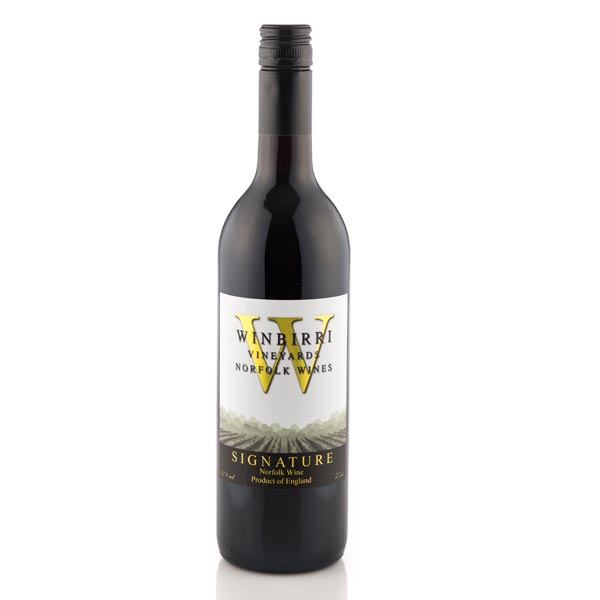


Winbirri Vineyards Norfolk Wine Signature
£14.46
ABV
12%
Bottle Size
75cl
Country
England
Tasting Guide
Bold ripe red berry fruit and spicy, oak aromas. Broad and expansive on the palate, with rich thick black fruit balanced by crunchy red berry flavours.
About Winbirri Vineyards
Winbirri Vineyards is a 25 acre (10 hectare) still and sparkling wine producer, based on the edge of the Norfolk Broads National Park. The name Winbirri, comes from the Anglo-Saxon ‘win’ (wine) and ‘birri’ (grape). Winbirri Vineyards is based in Surlingham, an important Anglo-Saxon settlement. It was established in 2007 by experienced fruit farmer, Stephen Dyer, who supplies major retailers. He spotted an opportunity and planted around 2½ acres with vines. Stephen’s son, Lee, took over at the age of 32 in 2010 when the first commercial plantings took place. Previously, Lee had held various roles in events, sales and marketing, business development and food distribution and had travelled extensively in Australia and South East Asia. He signed up for a number of intensive viticulture, oenology and wine skills courses at Plumpton College in East Sussex and immersed himself in winemaking literature before taking the plunge and has not looked back since. Passionate, forward-thinking and talented, Lee is meticulous about looking after the vineyard. “Quality is everything here at Winbirri,” says Lee. “It all begins in the vineyard. To make the best wines, you need the best grapes.” Meticulous attention to detail is given to the vines, with yields carefully controlled at two tonnes per acre to maintain his high standards. Every improvement, however small in itself, combined with other tweaks makes a real difference and the end result really shines through.” Lee likes to be in control and manages everything in-house – something, he believes, that is essential to guarantee top quality. He just focuses on his own wine and does not produce wine for anyone else. Lee has expanded Winbirri Vineyards, with a further 10,000 new Bacchus vines being planted in spring this year but not at the expense of quality. “Keeping growth in check is very important or the quality suffers. You can’t plant too many new vines in one hit or the rest of the vineyard will suffer.” All sites have been carefully selected so that they are not in frost pockets and each site has a lower-lying field for the frost to run off to. Mildew can be a cause for concern if not kept in check. The soils are very light, sandy loams with clay about 6ft down. There is a high flint content and all pruning is carried out by hand. It’s a real family affair at Winbirri Vineyards with six family members pruning, grape-picking, pressing and bottling and an extra three employees at busy times such as harvest. Lee has already invested in a modern winery on-site, enabling processing to start within minutes of the grapes being picked. The equipment is all state-of-the-art, preventing oxidation and minimizing the use of sulphur dioxide. Fermentations are all temperature-controlled by computer and all bottling is done on-site with a brand new GAI bottling plant, enabling inert conditions for the wine. There are plans to purchase a disgorging machine and more tanks to keep up with the additional volume of wine coming on stream. Currently, Winbirri Vineyards produces around 50,000 bottles a year but recent plantings in this year will drive that figure up. Winbirri also offers tours and tastings throughout the year. The Four vineyards, which are all managed by Lee, are planted to Bacchus, Pinot Noir, Solaris, Rondo and Seyval Blanc with Bacchus the main focus (most of the new plantings will be Bacchus – around 10,000 vines). Rather unusually, at Winbirri, white and sparkling wines account for 60% of production and red for 40% compared to a nation average of 95%/5%. “I see red wines playing a big part in our future, especially Pinot Noir,” says Lee. “Sparkling wine will also feature - nearly a third of the vineyard is planted to sparkling varieties, but I’m certainly not jumping on the band wagon and only heading in a sparkling route.
East Anglia
As a wine region, Norfolk is not as well-known as Kent, Sussex, Hampshire and Cornwall but temperatures are similar to those around the south coast areas and it is one of the driest regions in the UK which gives the region a huge advantage when it comes to the critical ripening period when some regions are more exposed to disease pressure from Botrytis. In September, Plumpton has an average rainfall of 80mm where as in East Anglia, it’s just 50mm. Bacchus prefers a drier climate and has become East Anglia’s ‘signature’ wine – aromatic and elegant. Over half of the Bacchus grapes grown in the UK are in East Anglia. “Norfolk has so much potential as a wine region, particularly when it comes to still wines. I think Bacchus has to be the jewel in the crown and, more importantly, for my site as it just works so well here. The flavour profiles and aromas we can achieve here from our vines are second to none! We have more sunshine and less rainfall here, especially in September, giving us the edge when it comes to the all-important ripening time. I’m in this for the long-haul and am looking forward to giving Sussex, Kent and the rest of the south coast a good run for their money over the next few years.”
Reviews
There are yet no reviews for this product.

